
Tree Surgeon in Cobham
Looking for a tree surgeon in Cobham? Treemedic are based in Hersham, fifteen minutes up the A3, and we work across Cobham, Stoke d’Abernon, Downside, Oxshott and the Tilt.
Cobham is not straightforward ground for tree work. It has five separate conservation areas . More than anywhere else in Elmbridge, the River Mole running through the middle of it, and a lot of large plots with mature specimen and veteran trees that need managing properly rather than cutting back hard. A fair number of Cobham trees are protected, and plenty of homeowners don’t find that out until after they’ve had someone in.
Crown reduction, deadwooding, felling, stump grinding, hedge cutting, TPO and conservation area applications, and 24/7 emergency call-outs. BS3998 standards, NPTC qualified, fully insured, free written quotes.
Call 07522 167 197.
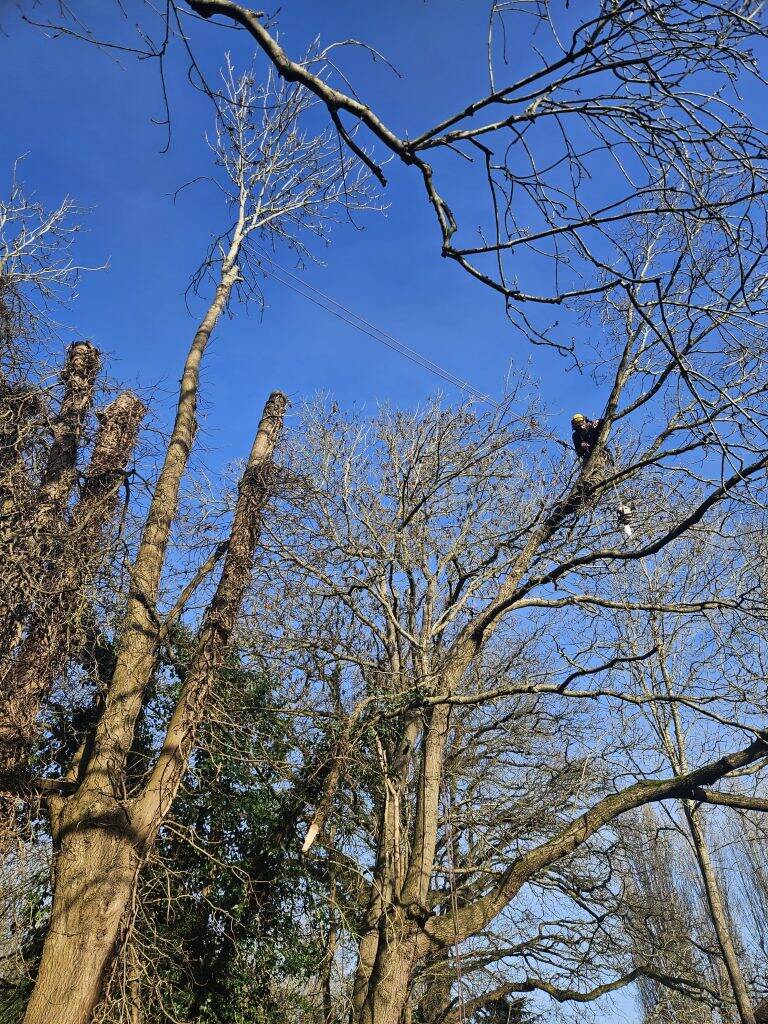
Our Tree Surgery Services in Cobham
We cover the full range of tree surgery and arboricultural work in Cobham including:
- Tree Pruning & Crown Reduction – Maintain structure, improve light, and reduce weight.
- Tree Felling & Removals – Safe dismantling and removal in restricted or complex areas.
- Stump Grinding – Clear unwanted stumps quickly and effectively.
- Hedge Cutting & Maintenance – Precise trimming, shaping, and seasonal maintenance.
- Tree & Hedgerow Planting – Professional planting to enhance gardens and landscapes.
- Emergency Tree Work – 24/7 call-outs for storm damage and hazardous trees.
All work is carried out in line with BS3998 tree work standards and local authority requirements, ensuring quality and compliance every time.
Trusted Local Tree Surgeons in Cobham
Tree Work Across Cobham’s Very Different Areas
Church Cobham and the Mill
The historic core along Church Street, Mill Road and River Hill sits tight against the River Mole. Wet ground, mature riverside willow, alder and poplar, and some significant old specimens. Cedar House isn’t named after nothing. Tight access, listed buildings either side, and everything inside a conservation area designated back in 1973.
The Tilt
A linear settlement strung along a series of commons, which makes for a lot of boundary trees where ownership and responsibility aren’t obvious. Oak, birch and scrub encroaching from common land into gardens is the standard job here.
Stoke d’Abernon
More river frontage, big plots, and mature parkland-style planting around the church and manor house end. Some of the finest garden trees in Surrey are down here.
Downside, Oxshott and the wider fringe
Green Belt on three sides, so gardens back onto woodland and heath. Constant self-seeded oak, sycamore, ash, birch and holly, plus large-scale hedging and boundary screening on the bigger properties.
What that means in practice
Cobham work is rarely “just take that tree down.” It usually involves checking protected status first, working around access constraints, and being honest about whether the tree needs what you’ve asked for. On a mature cedar or a veteran oak, a heavy reduction can’t be undone, you lose the form permanently and often trigger decline.
We’ll tell you when the right answer is smaller than the one you were expecting. Ryan has over a decade of climbing behind him and has worked mature trees across the UK, Australia, New Zealand and Scandinavia. On trees of this age and value, that judgement is the thing worth paying for.
Cobham Has Five Conservation Areas. Yours May Be In One
More of Cobham is protected than most residents realise. Elmbridge Borough Council maintains four separate conservation areas across the Cobham area:
Cobham (Church Cobham)
Designated on 31 July 1973 by Surrey County Council, based around the historic village core and the River Mole. It takes in Mill Road, River Hill and Church Street. Listed buildings within it include the Grade I Church of St Andrew, the Grade II* Ham Manor, Cedar House and Church Stile House, and Grade II Cobham Mill. A Character Appraisal and Management Plan was endorsed by planning committee on 11 June 2019.
The Tilt
Designated by Elmbridge on 31 July 1979 and extended on 10 March 2015. The council describes it as a linear settlement made up of a series of enclosed and partially enclosed open areas, formerly part of a much larger area of common land. Those commons are central to the area’s character, which matters if your boundary runs along one.
Stoke d’Abernon
Designated in 1979 and extended northwards in 1989. Centred on the ancient church and manor house on the banks of the River Mole. St Mary’s is Grade I listed and of outstanding importance, retaining Saxon fabric with a 10th century nave.
Downside Village
Designated by Elmbridge on 31 July 1979 and extended on 25 March 2014. Downside is a small rural village two miles south of Cobham centre, built around a large rough triangular common and surrounded by 19th century cottages. The council’s own description places the whole village against a well-wooded rural landscape, much of it owned and managed by the Cobham Park Estate, and notes it sits entirely within the Green Belt. A Character Appraisal and Management Plan was endorsed in March 2014, and there’s an active advisory committee.
Cobham (Plough Corner)
Designated by Elmbridge on 28 November 1990. Based on the group of buildings around the junction of Downside Road and Plough Lane, together with a substantial portion of Cobham Park including the House and its Lodge. So the designation takes in landscaped grounds, not just buildings.
What this means for your tree
Inside any of these boundaries, a tree with a trunk over 75mm diameter measured at 1.5m from the ground needs six weeks’ written notice to Elmbridge Borough Council before any work is carried out. Pruning counts, not just felling. During that six weeks the council can serve a Tree Preservation Order.
If a TPO is already in place, you need formal consent, which takes longer than the notice period. Unauthorised work on a protected tree is a criminal offence. Fines up to £20,000 on summary conviction and unlimited in Crown Court for higher value trees. In Cobham, where a single mature cedar can be worth a substantial sum in amenity terms, “higher value” is not hypothetical.
Cobham also has an active Conservation Area Advisory Committee and a well-organised local heritage trust, so applications here genuinely do get scrutinised.
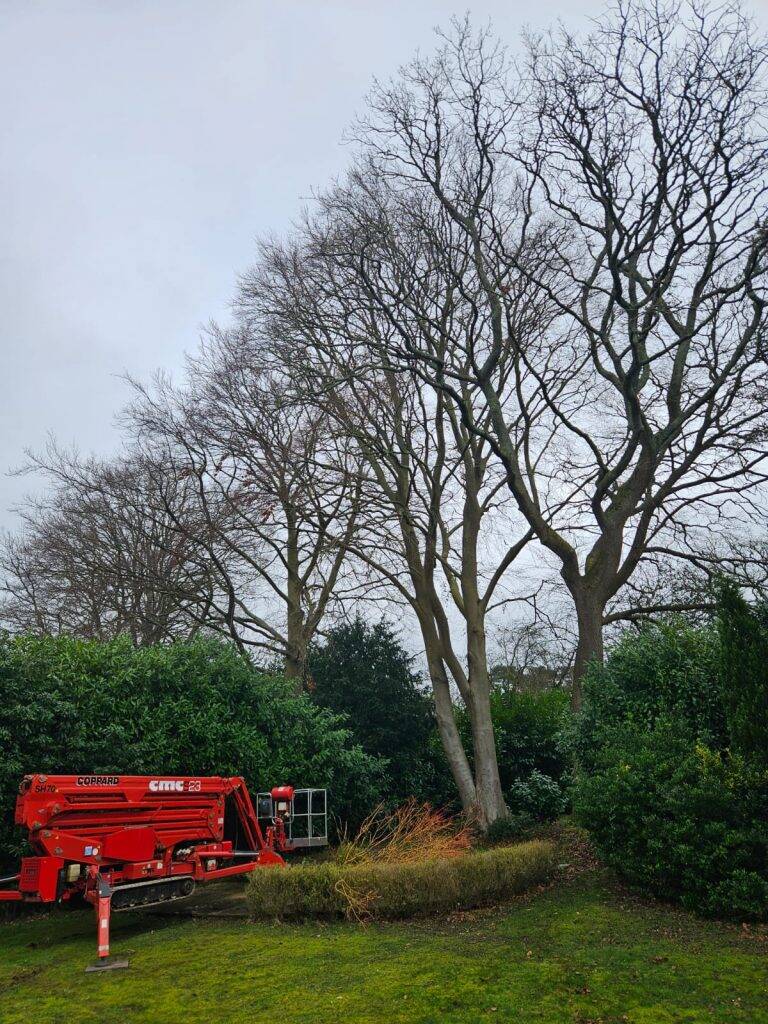
TPO and Conservation Area Applications in Cobham
Because so much of Cobham is protected, a large share of the work we do here starts with paperwork rather than a chainsaw.
What we do as part of the job:
- Check whether your tree carries a TPO or sits inside a conservation area boundary before we quote.
- Write and submit the Section 211 conservation area notice or the TPO consent application.
- Provide the arboricultural justification, the reasoning the tree officer actually needs, rather than a one-line request that gets refused or sat on.
- Deal with the council directly if they come back with questions.
- Produce completion reports where works are tied to a planning condition.
Why it matters who writes it
A refused application costs you months. Applications get refused when the justification is thin. “The tree is too big” isn’t a reason, “the tree has significant included bark at the primary union with associated cracking, and a 15% reduction will lower the failure risk while retaining amenity” is. We write these regularly for Elmbridge, Kingston and Richmond and we know how each authority wants it presented.
If a tree is genuinely dangerous
There’s an exemption allowing urgent work, but you still have to notify the council and you need evidence the danger was real. Nobody should be telling you they’ll take it down now and deal with the paperwork later.
The River Mole: Waterlogged Ground and Windthrow
The Mole runs through Church Cobham and Stoke d’Abernon, and it shapes the tree work along its length.
Saturated ground for months of the year means root plates on larger trees are working with far less anchorage than they look like they have. A mature poplar, willow or crack willow on wet ground doesn’t need an exceptional storm to come over, it needs an ordinary one at the wrong time of year.
Signs worth acting on:
- A tree that has developed a lean, particularly a recent one.
- Ground lifting, cracking or heaving on one side of the base.
- Soil pulling away from the trunk.
- A tree that moves noticeably at the base in wind rather than flexing in the crown.
Any of those on a large tree near a house, road or boundary is worth getting looked at rather than left. Crack willow does exactly what the name suggests, and a lot of the riverside planting along the Mole is reaching the age where limb failure becomes routine.
We can also look at cyclical management for riverside trees. Regular pollarding or reduction keeps the sail area and weight down, which is far cheaper than dealing with the aftermath.
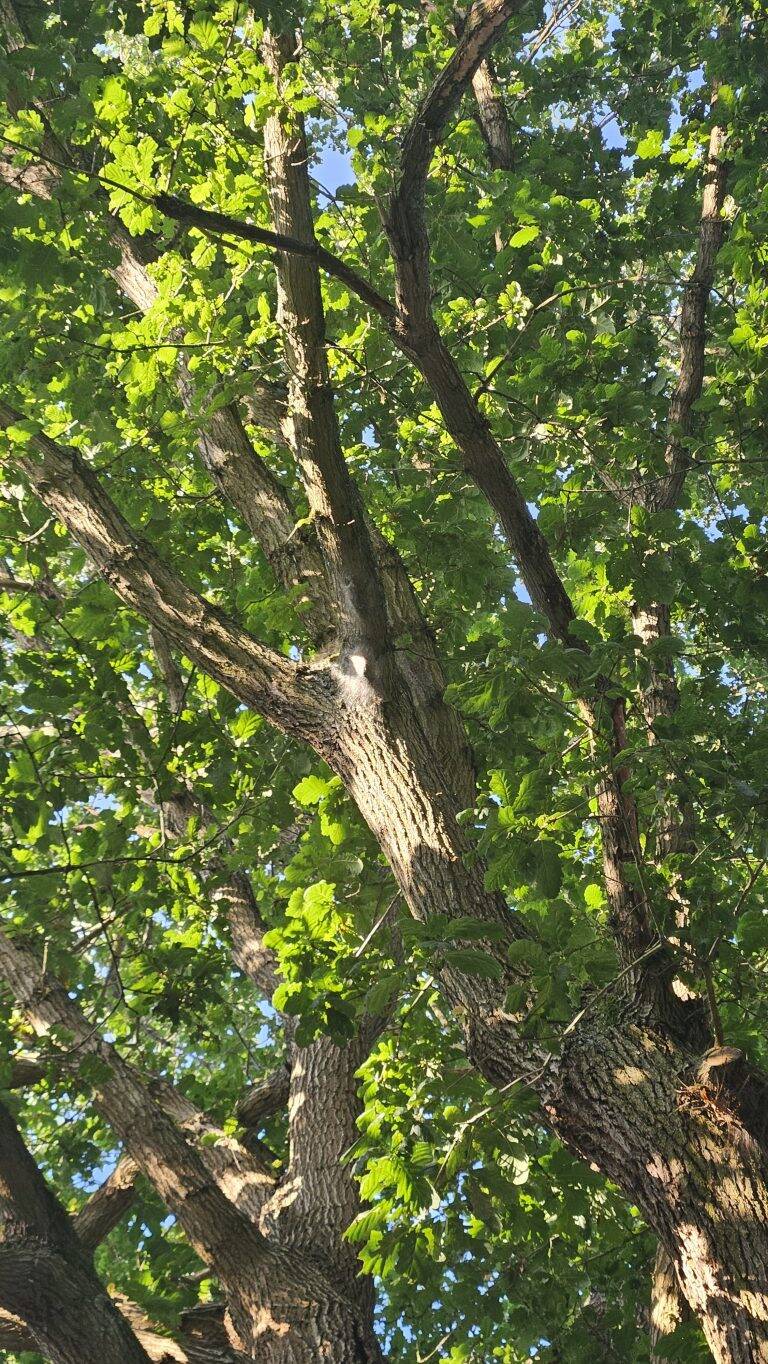
Oak Processionary Moth in Cobham
Elmbridge sits within the affected zone for Oak Processionary Moth, and Cobham has a very high oak population, mature garden oaks, boundary oaks along the Tilt commons, and estate trees on larger plots where an infestation can go unnoticed for weeks.
Between roughly May and July, watch for caterpillars moving nose-to-tail in processions up and down the trunk, and white silken nests where branches meet the stem. The hairs cause skin rashes, eye irritation and breathing difficulties in people, dogs and horses, and old nests remain hazardous long after the caterpillars have moved on.
Do not attempt removal yourself and never pressure-wash a nest, that aerosolises the hairs and makes the situation considerably worse. Keep children and animals away from the tree.
We’re Lantra trained for OPM removal and work in full respiratory protection with proper containment and controlled disposal. If you think you’ve spotted it, call and we’ll come and identify it before anything else happens.
Why Choose Treemedic Ltd
- Qualified, experienced & fully insured arborists
- Local, family-run business based near Cobham
- Environmentally conscious and BS3998 compliant
- Competitive, transparent pricing
- Free, no-obligation quotes & expert advice
- 24/7 emergency call-out service available
Tree Surgeon in Cobham: Common Questions
Do I need permission to cut down a tree in Cobham?
Quite possibly. Cobham has five conservation areas – Church Cobham, The Tilt, Stoke d’Abernon, Downside Village and Plough Corner – plus a high number of TPOs. Inside a conservation area, any tree over 75mm trunk diameter at 1.5m needs six weeks’ written notice to Elmbridge before any work, pruning included. We check before quoting.
How do I find out if my tree has a TPO?
Elmbridge hold the register and publish conservation area maps on their planning pages. Or just ask us — we check it as part of every Cobham quote and we’ll tell you exactly where you stand.
How long does a tree application take in Cobham?
A conservation area notice is six weeks from the date the council validates it. A TPO consent application typically takes eight weeks or longer. Plan around this — it’s the single most common reason Cobham jobs get delayed.
I've got a big tree near the river that's started leaning. Should I worry?
Probably, yes. Leaning combined with lifted or cracked ground on one side suggests root plate movement, and on saturated ground near the Mole that’s a tree that can come over in an ordinary winter storm. Get it inspected.
Can I cut back branches overhanging from next door?
You’re entitled to cut back to the boundary line and should offer the cuttings back. If the tree has a TPO or is in a conservation area you still need consent first, even for overhanging growth. In Cobham, assume it might be protected until you’ve checked.
Are you insured?
Fully, public liability and employers’ liability, certificates available before we start. Given the value of the trees and properties here, this isn’t a corner to cut. Ask any tree surgeon for theirs.
What happens to the waste?
It goes with us. Treemedic Ltd is registered with the Environment Agency as a waste carrier, and all arisings are transferred only to appropriately licensed facilities in accordance with our Duty of Care under the Environmental Protection Act 1990. Timber can be left cut to size for firewood if you want it, just say when we quote.
Areas We Cover In and Around Cobham
We cover Cobham including Church Cobham, Cobham High Street, Mill Road, River Hill, the Tilt, Leigh Hill, Downside, Downside Common, Stoke d’Abernon, Oxshott and Fairmile.
We’re across the rest of Elmbridge daily Esher, Hersham, Walton on Thames, Weybridge, Claygate, Thames Ditton and East Molesey. Plus Kingston, Wimbledon and Richmond.
Not sure if we cover your postcode? Give us a ring and we’ll tell you straight away.
