Best Tree Surgeon in Surrey
Who’s the Best Tree Surgeon in Surrey?
If you’re searching for the best tree surgeon in Surrey, here’s the honest answer: nobody can tell you who’s best, including us.
What we can do is tell you exactly what to check before you let anyone near your trees: insurance, qualifications, waste registration, and whether they’ll be straight with you about what the tree actually needs. Get those right and you’ll end up with a good firm, whether that’s us or not.
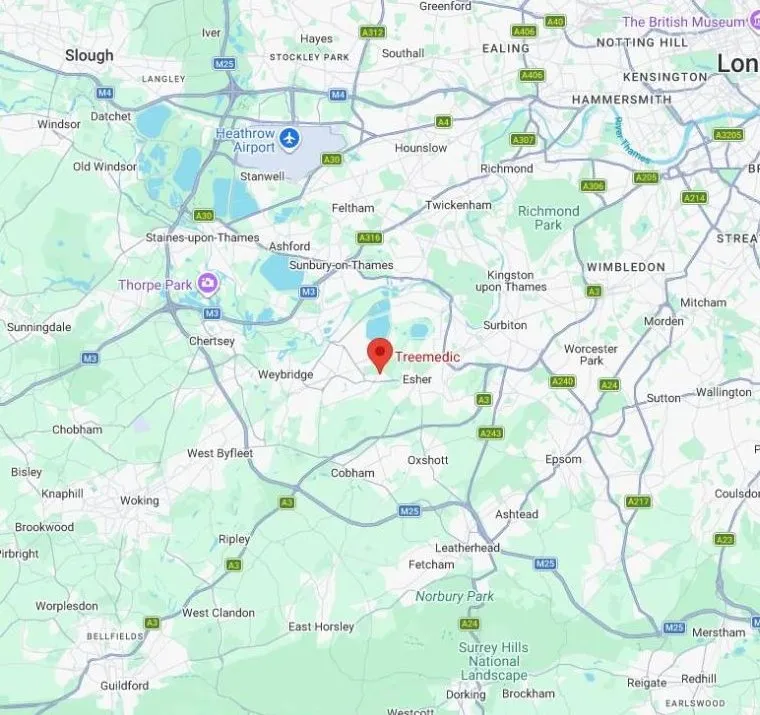
Treemedic Ltd is based in Hersham and covers Surrey and South West London. Rated 5 stars from 150+ Google reviews, fully insured, and every job carried out to BS3998 standards.
The rest of this page is the checklist. Use it on us and on anyone else you’re considering.
Why Homeowners Choose Treemedic
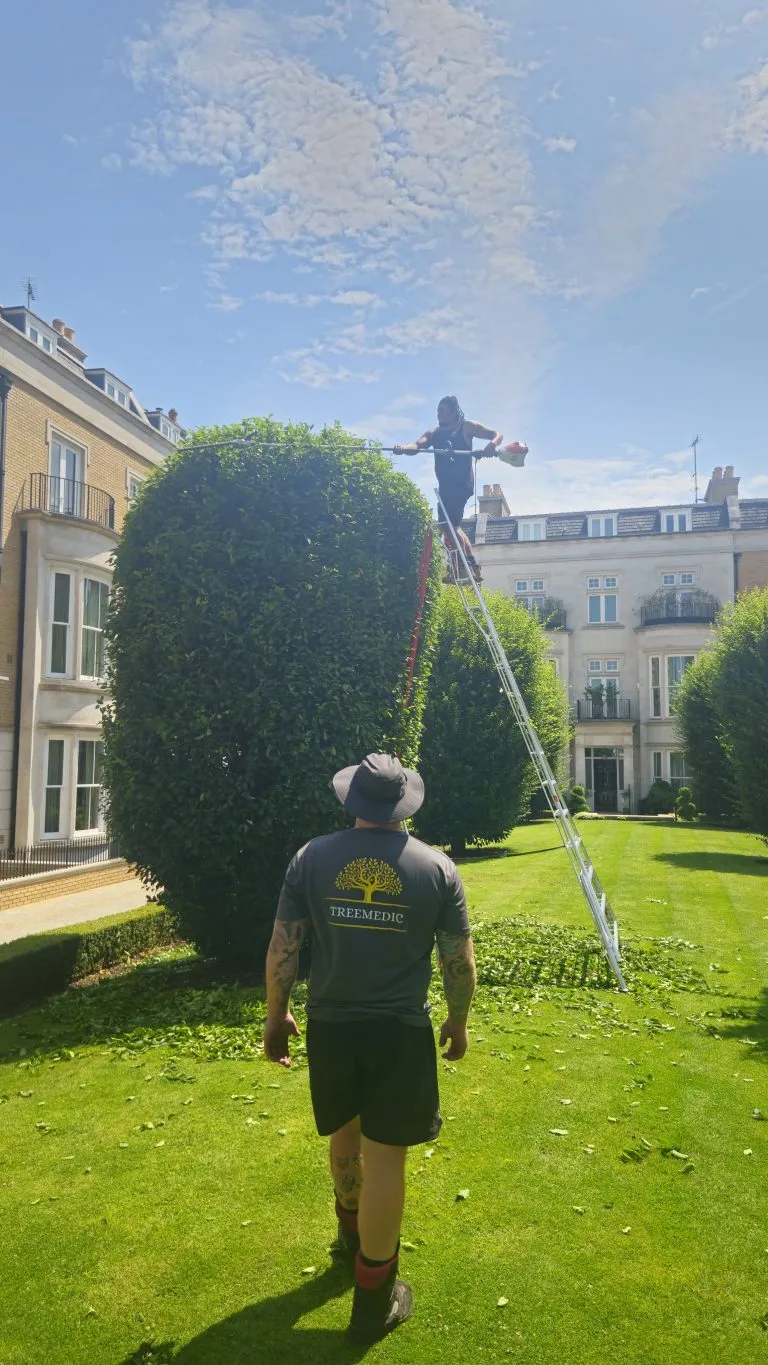
Treemedic was founded by Ryan Wileman, a tree surgeon and climber with over a decade of experience working across the UK, Australia, New Zealand and Scandinavia. That background means the crew turning up at your property has seen the full range of tree work, from routine pruning to storm-damage emergencies, and isn’t learning on the job.
We keep things straightforward: no hidden costs, no jargon, and no mess left behind. Every quote is free and comes with no obligation.
What we cover
- Tree pruning, crown reduction and crown lifting
- Tree felling and removal
- Stump grinding
- Hedge cutting and trimming
- Emergency call-outs for storm damage and fallen trees
- Oak Processionary Moth removal
- TPO and conservation area applications
How to Choose a Tree Surgeon: The Checklist
Tree surgery is unregulated. Anyone can buy a chainsaw and put “tree surgeon” on a van, and plenty do. Here’s what separates a professional outfit from someone who’ll leave you with a butchered tree, a damaged roof or a fly-tipping fine.
1. Insurance: ask to see the certificate
Ask for public liability and, if they have staff, employers’ liability insurance. Don’t take a verbal assurance. Ask them to email the certificates before work starts.
Check three things: that the policy is current, that the cover level is sensible for the work, and that the named insured matches the company you’re dealing with. A certificate in a different name is worth nothing to you.
If someone hesitates or gets defensive about this, that’s your answer.
2. Qualifications: the right ones for the job
Chainsaw and climbing work requires certificated training. Look for NPTC or Lantra certificates covering:
- Chainsaw maintenance and cross-cutting
- Felling
- Tree climbing and aerial rescue
- Aerial cutting techniques
Specialist work needs specialist training on top. Oak Processionary Moth removal in particular requires it. The caterpillar hairs cause serious respiratory and skin reactions, and it’s not a job for a general crew in ordinary PPE.
3. BS3998
This is the British Standard for tree work. It covers how cuts are made, how much can safely be removed, and what constitutes good practice. If someone quoting you hasn’t heard of it, that tells you something.
4. Waste carrier registration
Whoever takes your arisings away needs to be registered with the Environment Agency. If they aren’t, and your waste ends up dumped in a lay-by, it can be traced back to you, and under Duty of Care you can be fined for it.
The register is public and searchable. It takes thirty seconds to check.
5. Whether they check protected status
Surrey and South West London are heavily protected. Richmond alone has 85 conservation areas. Elmbridge has 26. Mole Valley has around a thousand TPOs.
A professional firm checks whether your tree is protected before quoting, and tells you if an application is needed. Someone who doesn’t ask is either inexperienced or hoping you won’t find out. Unauthorised work on a protected tree is a criminal offence for which you, as owner, can be prosecuted alongside the contractor.
6. Genuine reviews
Look at the pattern, not the number. Reviews spread over years read differently from twenty posted in the same fortnight. Read the three-star ones. How a firm responds to criticism tells you more than the five-star reviews do.
And check the reviews are on a platform the business can’t edit. Testimonials on a company’s own website are worth considerably less than Google reviews.
7. A written quote
Not a number over the phone. A written quote that specifies the work in a way you could hold them to.
What about trade body membership?
The Arboricultural Association runs an Approved Contractor scheme, and it’s a reasonable signal if you find one. But it’s a paid, voluntary scheme with a substantial audit process, and plenty of very good small firms aren’t members simply because of the cost and the admin involved.
Treat it as a bonus rather than a requirement. The insurance, qualifications and waste registration checks above matter more – those are pass or fail. Membership of a trade body isn’t.
Red Flags
Any one of these is worth pausing over. Two or more and we’d walk away.
Cold callers
“We’re working in the area and noticed your tree.” Legitimate firms are usually booked weeks out and don’t need to door-knock.
Cash only, no paperwork
No invoice means no comeback, no warranty, and no evidence for an insurance claim if something goes wrong.
Pressure to decide today
Discounts that expire this afternoon are a sales tactic, not a price.
Offering to “top” your tree
Topping – cutting the crown off at an arbitrary height – isn’t a recognised arboricultural practice. It lets decay in at every cut, forces weak regrowth, and produces a more dangerous tree within a few years. Anyone offering it either doesn’t know or doesn’t care.
No mention of protected status
See point 5 above.
Large payment demanded upfront
A deposit on a big job is reasonable. Full payment before any work has started, for standard tree work, isn’t.
Vague about waste
“We’ll take it away” isn’t the same as being registered to.
What a Good Quote Looks Like
A proper quote should tell you exactly what you’re buying. Ours specify:
- Which trees, identified clearly, and what work on each
- How much is coming off: a percentage reduction or a target height, not “we’ll tidy it up”
- Whether protected status has been checked, and what that means for timing
- What happens to the waste and whether timber is being left
- What’s included and what isn’t: stump grinding is usually a separate operation with a different machine
- Access requirements, and any implications for the price
- A fixed price, not an estimate that moves on the day
If a quote doesn’t cover these, ask. A good firm won’t mind explaining. It’s how they avoid arguments later too.
Questions Worth Asking
Five that will tell you most of what you need to know:
“Can you send me your insurance certificates?” The single most useful question. Watch the reaction as much as the answer.
“Is my tree protected, and have you checked?” It separates the professionals from the rest instantly.
“What would you do if it were your tree?” You’ll get a different, more honest answer than to “what do I need doing?”
“Are you registered to carry waste?” And check the number on the Environment Agency register.
“What happens if the weather turns?” Decent firms have a plan and will tell you. It’s also a fair test of whether they’ll communicate when something goes wrong.
How Treemedic Measures Up
Run the checklist on us. Here’s where we stand:
Insurance
Public liability and employers’ liability, both current. We’ll email certificates before we start. Just ask.
Qualifications
NPTC-certificated climbers and groundsmen, plus Lantra-approved training in Oak Processionary Moth removal. Over a decade of hands-on experience behind the business.
BS3998
Every job, including the ones nobody’s checking.
Waste
Treemedic Ltd is a registered waste carrier with the Environment Agency, registration CBDL644967. Check it on the public register if you like.
Protected status
We check before we quote, every time. If an application is needed we write it and submit it, with the arboricultural justification the tree officer actually wants to see. We do these regularly across nine different planning authorities.
Reviews
5.0 stars from 150+ Google reviews, built up over years rather than a fortnight.
Written quotes
Fixed price, itemised, free, no obligation.
And the honest bit
We’ll tell you when a tree doesn’t need the work you’ve asked for, and we’ll tell you when a job is outside what we can safely do. Neither of those makes us money on the day. Both are why people call us back.
Best Tree Surgeon in Surrey: Common Questions
Who are the best tree surgeons in Surrey?
No one can honestly answer that, and be wary of anyone who claims to. What you can do is check the things that actually matter: current insurance certificates, NPTC or Lantra qualifications, BS3998 compliance, Environment Agency waste carrier registration, and a genuine review history built over years. Treemedic Ltd meets all of those. We’re based in Hersham with a 5.0 rating from 150+ Google reviews, but run the same checks on anyone you’re considering.
Is Treemedic Ltd a reputable tree surgery company?
Yes. Treemedic Ltd holds a 5.0 star rating from 150+ Google reviews, is fully insured, and follows BS3998 tree work standards on every job across Surrey and South West London.
What areas does Treemedic Ltd cover?
Treemedic Ltd is based in Hersham and covers Surrey and South West London across nine planning authorities: Elmbridge, Spelthorne, Runnymede, Mole Valley, Epsom & Ewell, Richmond upon Thames, Kingston upon Thames, Merton and Wandsworth.
What should I look for in a tree surgeon in Surrey?
Look for proof of insurance, relevant qualifications (such as NPTC or Lantra certification), compliance with BS3998 standards, and a strong track record of genuine customer reviews.
How much does tree surgery cost in Surrey?
Costs vary depending on tree size, access, and the work required, from routine pruning to full removals. Treemedic Ltd provides free, no-obligation quotes for all jobs across Surrey and South West London.
Does Treemedic Ltd offer emergency tree services in Surrey?
Yes, Treemedic Ltd provides emergency call-out tree services across Surrey and South West London for storm damage, fallen trees, and other urgent hazards.
How do I check a tree surgeon’s insurance?
Ask them to email the certificates before work starts. Check the policy is current, the cover level is appropriate, and the named insured matches the company you’re dealing with. Any professional firm will send them without fuss.
How do I know if my tree is protected?
Every council publishes conservation area maps and holds a TPO register. If you’ve recently bought, the local land charges search should have flagged it. Or ask your tree surgeon – a good one checks before quoting.
Can I be prosecuted if my tree surgeon works on a protected tree without permission?
Yes. Councils are explicit that both the owner and the contractor are liable. “My tree surgeon said it was fine” is not a defence, which is why it’s worth asking whether they’ve checked.
What is topping, and why do you not do it?
Topping is cutting the crown off a tree at an arbitrary height, leaving stubs rather than cutting back to a growth point. It isn’t recognised arboricultural practice. Decay enters at every cut, the tree responds with dense weak regrowth, and within a few years you have a more hazardous tree than you started with – permanently. What you probably want is a crown reduction.
Should I only use an Arboricultural Association Approved Contractor?
It’s a reasonable signal, but not a requirement. It’s a paid voluntary scheme with a significant audit process, and plenty of competent small firms aren’t members because of the cost and admin. Insurance, qualifications, BS3998 and waste carrier registration are the checks that genuinely matter. Those are pass or fail.
Areas We Cover
We cover Surrey and South West London including Hersham, Walton on Thames, Esher, Cobham, Weybridge, Thames Ditton, East Molesey, Shepperton, Kingston, Richmond, Twickenham, Teddington and Wimbledon.
For the full picture, including a council-by-council guide to tree protection rules across the area, see our Surrey tree surgeon page.
Not sure if we cover your postcode? Give us a ring and we’ll tell you straight away.
Contact Treemedic Ltd
Give us a ring on
07522 167 197 or 020 3488 8694
for a free no-obligation quote. Or fill in the form below and we’ll get back to you, usually the same day.