Tree Surgeon in Richmond
Looking for a tree surgeon in Richmond? Treemedic cover Richmond, Richmond Hill, Petersham, Ham, Kew and East Sheen, working across the borough from our base in Hersham.
Richmond is not straightforward ground for tree work. The London Borough of Richmond upon Thames has 85 conservation areas, more than any other London borough, and between them they cover a very large share of the housing stock. It also has one of the highest concentrations of Tree Preservation Orders in the capital, and it’s the original UK outbreak area for Oak Processionary Moth.
Tree pruning, crown reduction, felling, stump grinding, hedge cutting, Section 211 and TPO applications, OPM removal and 24/7 emergency call-outs. All to BS3998 standards, NPTC qualified, fully insured, free written quotes.
Our Tree Surgery Services in Richmond
We cover the full range of tree surgery and arboricultural work in Richmond including:
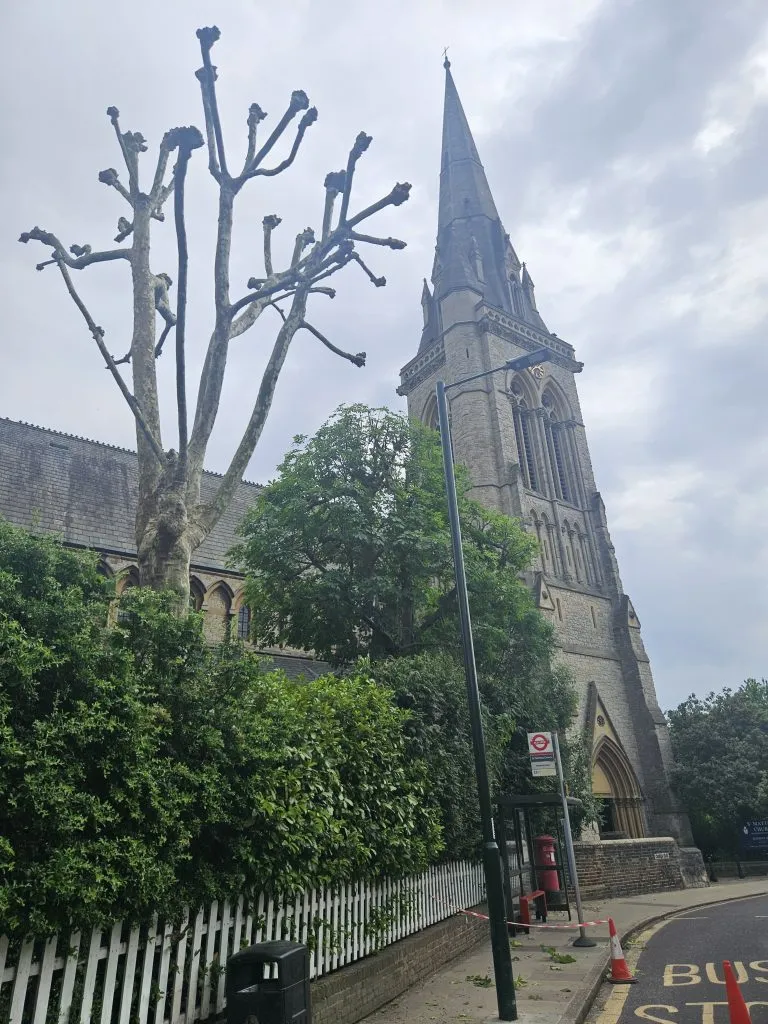
- Tree Pruning & Crown Reduction – Improve structure, light and shape.
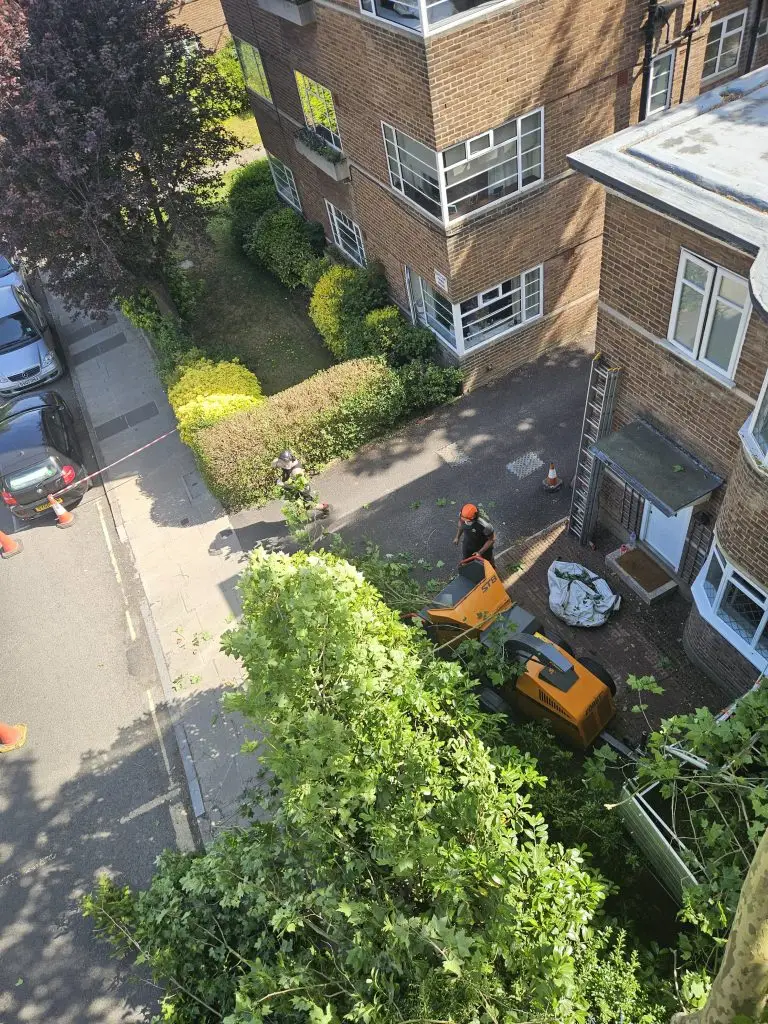
- Tree Felling & Removals – Safe dismantling and removal, even in confined spaces.
- Stump Grinding – Clear unsightly stumps quickly and prevent regrowth.
- Hedge Cutting & Maintenance – Precise trimming and shaping for gardens and commercial sites.
- Tree & Hedgerow Planting – New trees and hedges, planted properly and looked after.
- Emergency Tree Work – 24/7 call-outs for storm damage or fallen trees.
All our work follows BS3998, the British Standard for tree work, so every cut is one we can stand behind.
Richmond’s Trees, and Why They Need Handling Carefully
Richmond Hill and the terraces
Georgian and Victorian property with mature garden trees that predate much of the housing: plane, lime, horse chestnut, cedar and holm oak. Tight plots, restricted rear access, listed buildings either side. Sectional dismantling with everything coming out through the house or rigged over the roof is routine here rather than exceptional.
Petersham and Ham
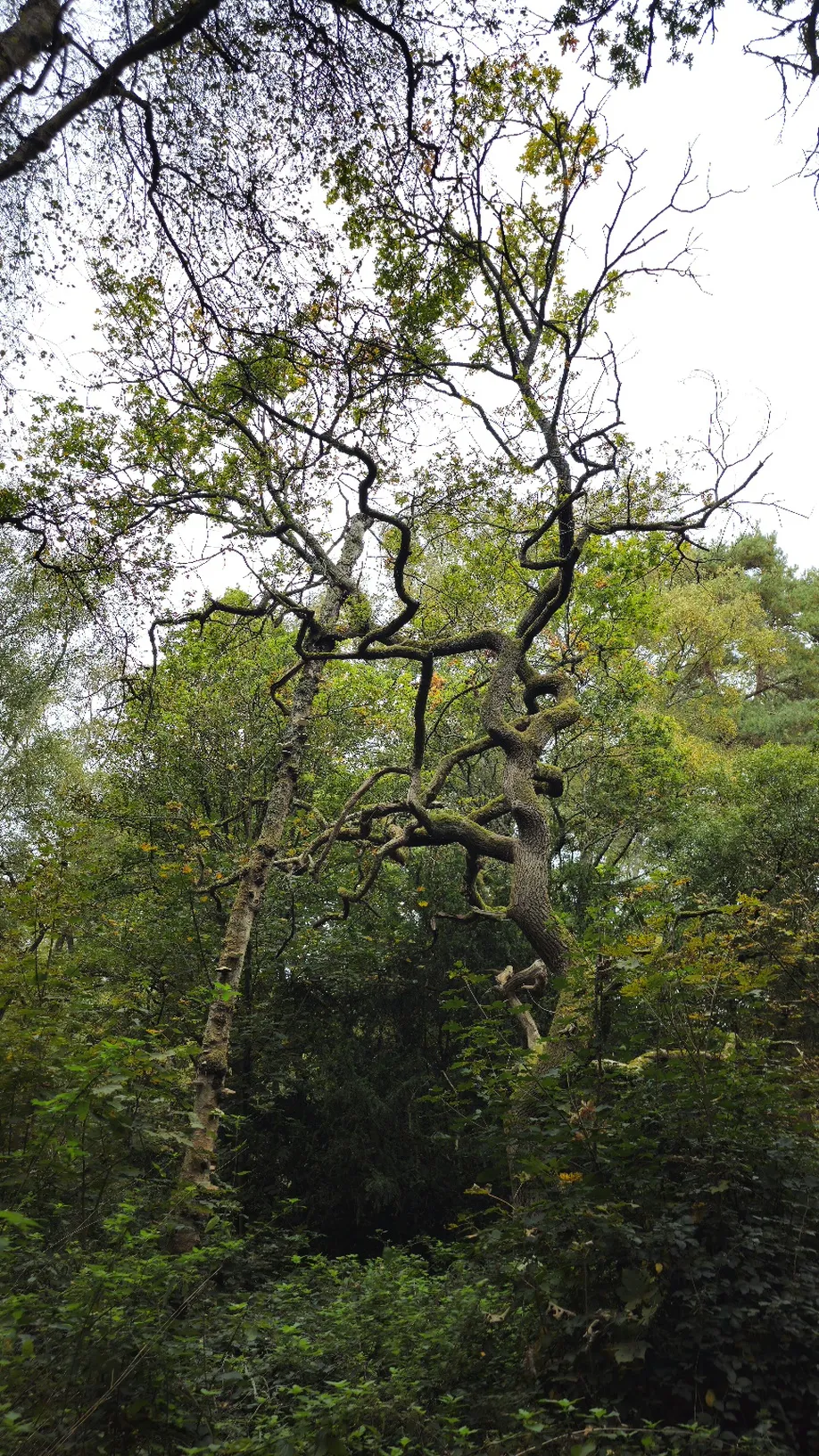
Large plots backing onto Ham Common and Petersham Meadows, with substantial specimen and veteran trees. Ancient oak, sweet chestnut and cedar, much of it descended from the old estate planting around Ham House. These are trees where heavy-handed work does permanent damage.
Kew and the riverside
Willow, poplar, alder and crack willow on ground that holds water for months of the year. Root plates working with far less anchorage than the size of the tree suggests, and more trees blown over in storms than anywhere else in the borough.
East Sheen and the newer roads
Heavy post-war planting of cherry, birch, conifer and ornamentals, most of it now well past the size the gardens were built for. Leylandii that started as a screen and is now thirty feet, birch three metres from a bay window, cherries with basal decay.
The honest bit
On a mature Richmond garden tree, the wrong work can’t be undone. A hard reduction on a cedar or a holm oak destroys the form permanently and often triggers decline, and you can’t buy the shape back at any price.
We’ll tell you when the right answer is smaller than the one you asked for. Sometimes that’s “this oak doesn’t need reducing, it needs deadwooding and a re-inspection in three years”. A smaller invoice for us and a better outcome for you. Ryan has over a decade of climbing behind him and has worked mature trees across the UK, Australia, New Zealand and Scandinavia. On a tree of this age, that judgement is what you’re paying for.
Richmond Has 85 Conservation Areas. Yours Is Probably in One.
That’s not a typo. The London Borough of Richmond upon Thames has 85 designated conservation areas, more than any other London borough, and between them they cover a very large share of the housing stock.
The council’s own description puts it plainly: they range from former historic villages like Hampton, to town centres like Richmond itself, to enormous open spaces including Richmond Park and the Royal Botanic Gardens at Kew, which is a World Heritage Site.
The practical upshot: if you own a tree in this borough, the sensible assumption is that it’s protected until you’ve checked otherwise.
What the rules actually say
In a conservation area
Trees within conservation areas are protected as part of the designation. Anyone wanting to cut down or prune one must give the council six weeks’ prior written notice using a Section 211 notice. The council then has six weeks to object. If they do object, they must make a Tree Preservation Order to extend protection to the tree. If you hear nothing within that period, you can go ahead with the planned works.
With a Tree Preservation Order
A full TPO application is required, and it covers felling, pruning and root pruning – a detail that catches people out when they’re putting in an extension or a driveway.
Doing it without permission
This is a criminal offence, and the council states plainly that it could result in criminal proceedings against the property owner or whoever carried out the works. Not just the contractor – the owner too.
Some trees are doubly protected
Trees in conservation areas may also carry a TPO, and may form part of a Registered Historic Park and Garden. In those cases the stricter process applies.
How to check
The council runs an online map service where you can look up whether your property sits in a conservation area. TPO records are held at the Civic Centre, or you can ring the council on 020 8891 1411. If you’ve recently bought, the local land charges search should have revealed both. It’s worth checking your solicitor flagged it.
What we do about it
We check protected status as part of every quote. If your tree needs a Section 211 notice or a TPO application, we write it and submit it for you – with the arboricultural justification the tree officer actually wants to see, rather than a one-line request that gets refused or sat on.
We do these regularly across Richmond, Elmbridge and Kingston, and we know how each authority likes them presented.
If you’re working to a deadline, start early
A conservation area notice runs a fixed six weeks from validation – the council either objects within that window or you’re free to proceed. TPO applications take longer and there’s no automatic approval at the end, so they need more lead time. Either way, it’s the most common reason Richmond jobs get delayed.
Neighbouring Trees and Overhanging Branches
Richmond council’s own guidance is clear on this, and it’s worth knowing where you stand before you pick up a saw.
Your neighbour is under no obligation to prune or remove a tree just because branches overhang your boundary or it blocks your light.
You may remove branches encroaching over your boundary without asking permission, but you must not cross the boundary to do so.
Offer the material back. The council specifically advises asking whether your neighbour wants the branches and other waste returned. If they don’t want it, disposal becomes your responsibility. Do not dispose of it over the fence.
Talk to them first
It’s the council’s own advice, and it saves a lot of grief.
But check protection before you start
If the tree has a TPO or sits in one of the borough’s 85 conservation areas, you need consent even for overhanging growth. In Richmond that’s a real risk, not a technicality.
Cutting hard on one side can also destabilise a tree, which leaves you liable if it later fails. We deal with a lot of these and we’ll tell you what you’re entitled to do and what’s actually sensible, which aren’t always the same thing.
Emergency Tree Work in Richmond
We run a 24-hour call-out with a staffed emergency line. You’ll speak to a person, not a voicemail.
Common call-outs here:
- Whole trees uprooted on saturated riverside ground at Kew, Petersham and Ham
- Large limb failures from mature and veteran trees, the most dangerous kind because of the weight involved
- Limbs down across driveways, cars and fences after high winds
- Storm-damaged trees hung up in neighbouring trees: genuinely dangerous, never tackle this yourself
- Branches into roofs and conservatories on the tighter terraced streets
If anyone is injured or trapped, call 999. If the tree is on power lines, call 105, the free national number for downed lines. Those calls come first; we’ll deal with the tree once the scene is safe.
On protected trees
There’s an exemption allowing urgent work where a tree is genuinely dangerous, but you still have to notify the council afterwards, and you need evidence the danger was real. We document the condition properly and handle that notification. Nobody should be telling you to take a protected tree down and sort the paperwork later.
For everything else, call 07522 167 197 any time and we’ll tell you honestly whether it needs someone out tonight or whether it can safely wait until morning.
Oak Processionary Moth in Richmond
Richmond matters more than most places for OPM, because this is roughly where it started.
OPM was first found breeding in the UK in West London in 2006, and Richmond and Kew were among the earliest affected sites. The borough now sits firmly within the established area, which means the management approach is about controlling impact rather than eradication, and it means a high chance of finding it on oaks here.
Richmond Park holds one of the largest collections of ancient oaks in Europe, and the borough has an enormous oak population in gardens, streets and open spaces to go with it.
What to look for
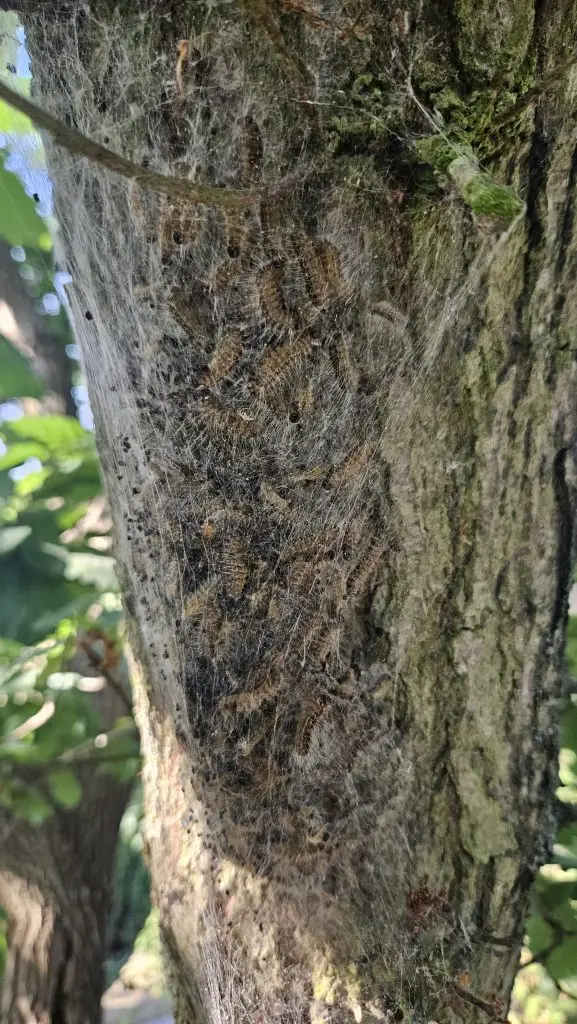
Between roughly May and July, caterpillars move nose-to-tail in single-file processions up and down the trunk and along branches. They build white silken nests where branches meet the stem. The processional behaviour is the giveaway: nothing else native does it.
The hairs cause skin rashes, eye irritation and breathing difficulties in people, dogs and horses, and old nests stay hazardous for years after the caterpillars have gone.
What not to do
Don’t touch it. Don’t knock the nest down. Never pressure-wash a nest: that puts the hairs into the air across a wide area and turns a contained problem into a serious one. Keep children and animals away from the tree and the ground beneath it, because the hairs accumulate in leaf litter.
We’re Lantra-trained in OPM removal and work in full respiratory protection with proper containment and controlled disposal. Photograph it from a safe distance and send it over, identification is free, and half the time it turns out to be something else – often harmless ermine moth, or brown-tail, which has irritant hairs too.
Richmond, in Short
- We work across a borough with 85 conservation areas, more than anywhere else in London, and we check protected status before we quote
- Section 211 notices and TPO applications written and submitted for you, with the justification the tree officer actually wants
- Crown reduction, felling, stump grinding, hedge cutting, all to BS3998 standards
- Lantra-trained for OPM removal, and Richmond is where it started in the UK
- Fully insured, NPTC qualified, certificates sent before we start if you want them
- Free, written quotes, the price we quote is the price you pay
Tree Surgeon in Richmond: Common Questions
Do I need permission to cut down a tree in Richmond?
Very probably. Richmond upon Thames has 85 conservation areas, more than any other London borough, plus a high number of Tree Preservation Orders. In a conservation area you must give six weeks’ prior written notice using a Section 211 notice before cutting down or pruning any tree. With a TPO you need a full application. We check before quoting.
How do I find out if my tree is protected?
The council runs an online map service showing conservation area boundaries. TPO records are held at the Civic Centre, or ring 020 8891 1411. If you’ve recently bought the property, the local land charges search should have flagged it. Or just ask us. We check as part of every Richmond quote.
How long does an application take?
A Section 211 conservation area notice is six weeks. The council has that period to object; if you hear nothing, you can proceed. TPO applications take longer.
Does a TPO cover root pruning?
Yes. A TPO application is required for felling, pruning and root pruning. Worth knowing if you’re planning an extension, a driveway or any groundwork near a protected tree.
What happens if I do the work without permission?
It’s a criminal offence, and the council is explicit that proceedings can be brought against the property owner as well as whoever carried out the works. Easily avoided by checking first.
My property has no rear access. Can you still do the work?
Yes, it’s normal in Richmond. Sectional dismantling with everything brought out through the house on boards and sheets, or rigged over the roof. It takes longer than an open-access job and we price it accordingly, but we’ll tell you what’s involved upfront rather than discovering it on the day.
Can I cut back branches overhanging from next door?
You can cut back to the boundary line and should offer the material back to your neighbour rather than throwing it over the fence. You must not cross the boundary to cut. And if the tree is protected you need consent first, even for overhanging growth, which in Richmond is a real possibility.
I think I’ve got oak processionary moth. What now?
Keep everyone and all pets away from the tree and the ground underneath it. Don’t touch it and never pressure-wash a nest. Photograph it from a safe distance and send it to us. Identification is free, and it’s often something harmless.
Are you insured?
Fully, public liability and employers’ liability, and we’ll send certificates before we start if you’d like them. Ask any tree surgeon for theirs. If they hesitate, don’t use them.
What happens to the waste?
It goes with us. Treemedic Ltd is a registered waste carrier with the Environment Agency (CBDL644967), and all arisings are transferred only to appropriately licensed facilities in accordance with our Duty of Care under the Environmental Protection Act 1990. Timber can be left cut to size for firewood if you want it, just say when we quote.
Areas We Cover in and Around Richmond
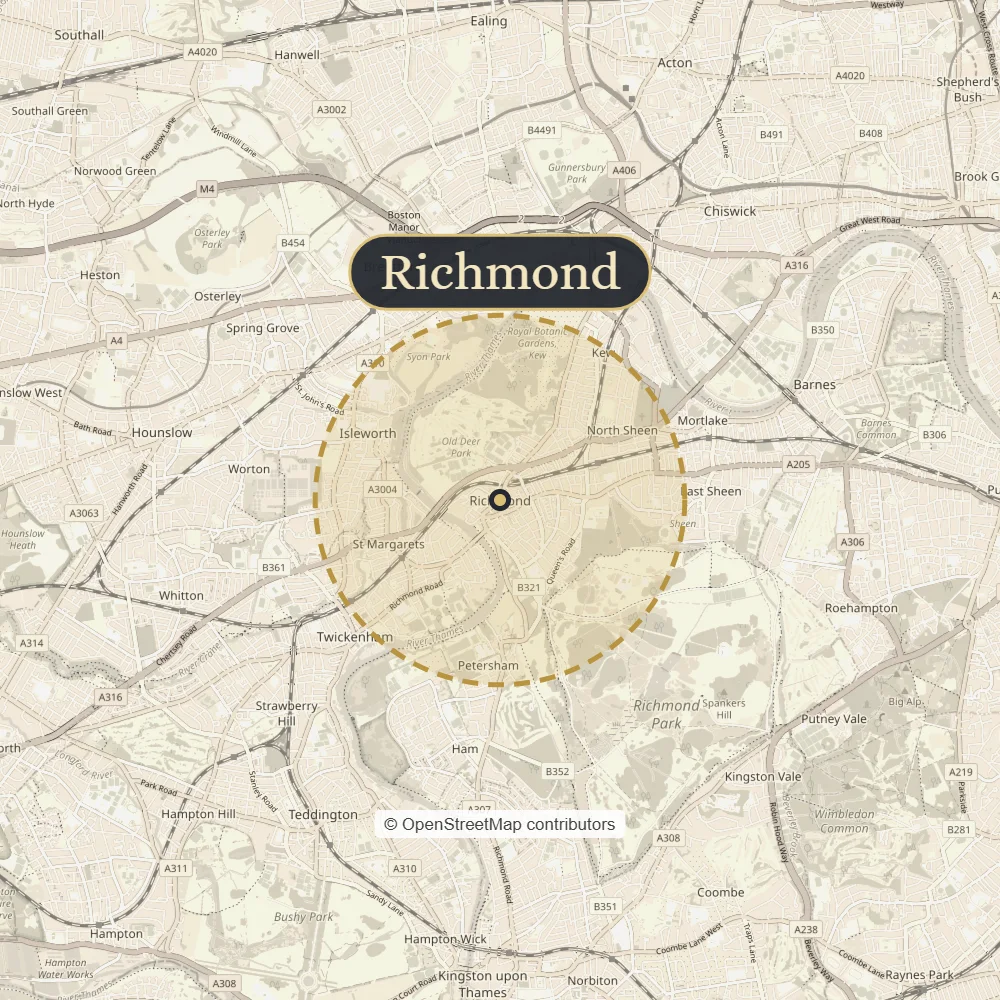
We cover Richmond including Richmond Hill, Richmond town centre, Petersham, Ham, Kew, North Sheen, East Sheen and Mortlake.
We’re across the rest of the borough too: Twickenham, Teddington, St Margarets, Whitton, Hampton and Hampton Wick, plus Kingston, Wimbledon, Barnes and Putney.
Further into Surrey we work daily in Hersham, East Molesey, Thames Ditton, Walton on Thames, Esher and Weybridge.
Not sure if we cover your postcode? Give us a ring and we’ll tell you straight away.
Contact Your Local Tree Surgeon in Richmond
Give us a ring on
07522 167 197 or 020 3488 8694
for a free no-obligation quote. Or fill in the form below and we’ll get back to you, usually the same day.