
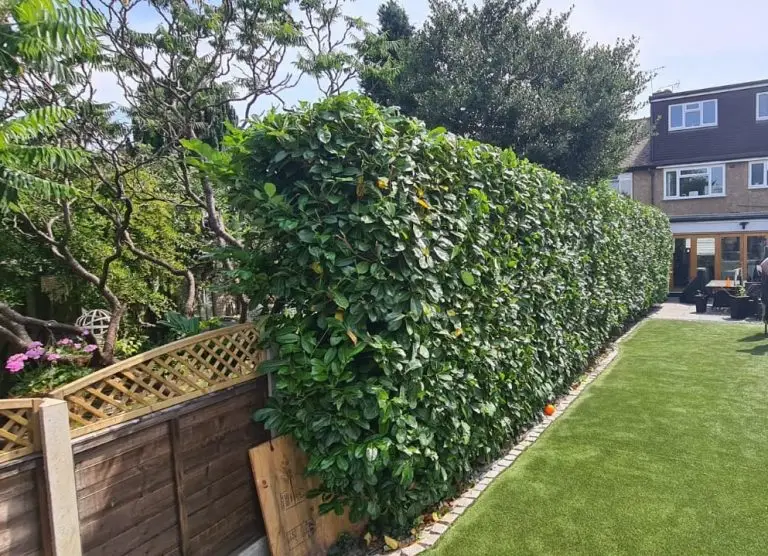
Leylandii and High Hedges: What You Can Do
Leylandii were planted in their thousands across Surrey and South West London as a quick privacy screen, and they did their job. The trouble is that they don’t stop. Left alone they can put on up to a metre a year, and a screen planted at fence height can tower over the house within a decade or two.
Whether it’s your hedge or the one next door, here’s what you can do about it.
If It’s Your Own Hedge
You’ve got three choices: keep it under control, take it down to a sensible height, or replace it.
- Regular trimming. Trimming two or three times between late spring and late summer keeps a leylandii hedge dense and green. Little and often is the key.
- Reducing the height. Leylandii can be taken down a long way in height. The top will stay flat at first, then thicken up from the sides over the next season or two.
- Removing it. If it’s simply too big for the garden, taking it out and replanting is often the better long-term answer. We can grind out the stumps so the ground can be replanted.
The one thing you can’t do is cut the sides back past the green. Leylandii won’t regrow from bare brown wood, so a hedge that’s cut too hard on the side will stay brown and patchy for good.
Why the Garden Near a Leylandii Struggles
Leylandii have a dense mat of shallow roots that takes a lot of water out of the ground, and a thick canopy that keeps rain off the soil underneath. That’s why lawns and borders next to a big conifer hedge so often struggle, even once the hedge has been cut down to size.
If you take a leylandii hedge out, it’s worth improving the soil with plenty of organic matter before you replant, so the new planting has a fair start.
Good Alternatives to Leylandii
If you’re replacing a leylandii hedge, there are plenty of options that give privacy without the runaway growth:
- Yew: slow to start, but dense, long-lived, and it regrows from old wood if it’s ever cut hard.
- Beech and hornbeam: keep their dead leaves through most of the winter, so they still screen well.
- Laurel: fast, evergreen and glossy, though it needs regular trimming.
- A mixed native hedge of hawthorn, hazel and field maple, which is great for wildlife.
See our tree and hedge planting page if you’d like us to plant it for you.
If It’s Your Neighbour’s Hedge
Start with a friendly conversation. Plenty of people don’t realise how their hedge looks from next door, and most of these situations get sorted over the fence.
In the meantime, you can cut back any branches that cross onto your side, up to the boundary, without asking. You can’t lean over or go onto their land, and you should offer them the cuttings back rather than putting anything over the fence. Be careful how hard you go: cutting a leylandii back into brown wood on your side will leave you looking at a bare, brown wall.
The High Hedges Law
If talking doesn’t work, the law gives you a way to ask the council to step in. Under Part 8 of the Anti-social Behaviour Act 2003, you can complain about a neighbour’s hedge if:
- it’s made up of two or more trees or shrubs in a line,
- it’s mostly evergreen or semi-evergreen, like leylandii, laurel or conifers,
- it’s over 2 metres tall,
- it acts as a barrier to light or access, and
- it’s affecting your reasonable enjoyment of your home or garden.
You have to show you’ve tried to sort it out with your neighbour first, and most councils charge a fee to look at a complaint, which you usually won’t get back.
If the council agrees there’s a problem, it can order the hedge to be cut down to a height that solves it and kept there. It can’t order the hedge to be removed or cut below 2 metres, and there’s no rule that hedges have to be 2 metres. Single trees aren’t covered at all. The full details are on the government’s high hedges guidance.
Permission and Nesting Birds
Hedges are rarely protected by a Tree Preservation Order, but in a conservation area, larger trees within a hedge can still need six weeks’ notice before they’re cut back. Our guide Do I Need Permission to Cut or Prune a Tree? explains how to check.
Conifer hedges are one of the most popular places for birds to nest, so from March to August we check carefully before we cut, and leave any active nests alone until the chicks have gone.
How We Help
We trim, reduce and remove leylandii hedges of every size, from a garden screen to a row of conifers taller than the house. We’ll tell you honestly what your hedge can take, whether it’s worth keeping, and what it would look like afterwards. If it’s coming out, we can grind out the stumps and replant.
Find out more on our hedge cutting page, ring 07522 167 197, or send us a few photos on WhatsApp.
Leylandii and High Hedges: Common Questions
How much can I cut off the top of a leylandii?
Quite a lot. Leylandii can be reduced in height by a good amount, and the top will thicken up from the sides over time. It’s the sides you need to be careful with, because they won’t regrow from brown wood.
Will a leylandii regrow if it’s cut back hard?
Not from bare brown wood. If you cut back past the green growth, that section will usually stay brown. That’s why regular trimming works better than an occasional hard cut.
When is the best time to cut a leylandii hedge?
Between late spring and late summer, ideally two or three light trims. Checking for nesting birds first is essential between March and August.
Is there a legal height limit for hedges?
No. There’s no law saying a hedge has to be kept to 2 metres. Under the high hedges rules, a council can order an evergreen hedge over 2 metres to be cut down to a height that fixes the problem, but only after a complaint, and never below 2 metres.
Can my neighbour make me cut down my hedge?
They can’t make you remove it. If your hedge is evergreen, over 2 metres and blocking their light, they can complain to the council, which can order it reduced in height and kept there.
Can you remove the roots so I can replant?
Yes. Once the hedge is down, we can grind out the stumps and main roots so the ground can be dug over and replanted.