
Cat Stuck in a Tree?
Here's What Actually Helps
If you’re reading this at the bottom of your garden with your neck aching and your cat looking down at you from twenty feet up we know. We’ve got two of our own, and they’re both perfectly capable of this.
The good news is that most cats sort themselves out. The RSPCA deal with over 100,000 of these enquiries a year, and their standing advice is to give the cat a chance to come down by itself first, because most of them do.
But “most” isn’t “all”, and we’re not going to pretend there’s a magic number of hours after which everything’s fine. Some cats are down by teatime. Some sit it out for days. What matters is knowing what to try, what makes it worse, and when it’s genuinely time to get someone with ropes.
Everything below is free advice. If you do need us in the end, the rescue itself is a paid call-out and we’ve explained exactly how that works further down — no surprises.
Why They Get Stuck
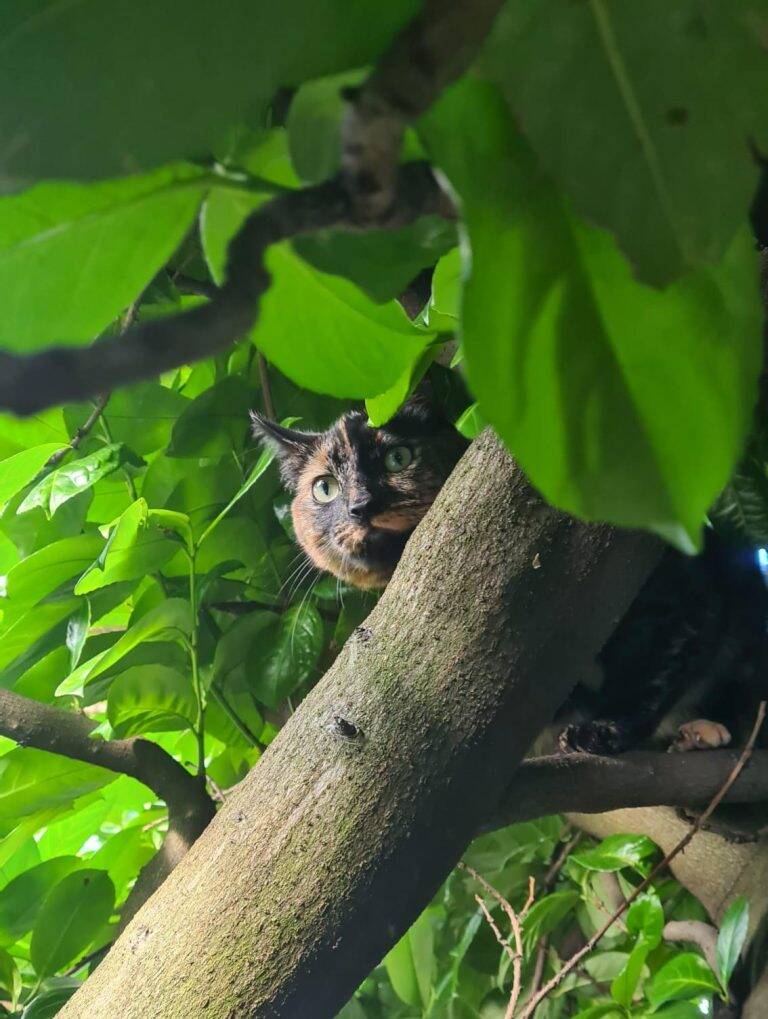
Cats are brilliant at going up and hopeless at coming down. Their claws curve backwards, which is perfect for hauling themselves up a trunk and completely useless in reverse.
To get down properly a cat has to back down tail-first, and plenty of house cats have simply never learned how. So they get to the top, look down, realise the problem, and freeze.
Your cat almost certainly isn’t trapped. It’s frightened, and it’s waiting for the world to feel calm enough to have a go.
Which is why the most useful thing you can do, and the hardest, is give them space.
A garden full of worried people looking up and pointing is exactly what keeps a cat where it is. They come down when it’s quiet, often at dusk, often overnight, and very often the moment everyone’s given up and gone inside.
What To Try
Clear the audience
Dogs indoors, children indoors, and stop standing underneath. If neighbours have come out to help, thank them and send them home. Watch from a window instead.
Build them a route down
This is the tip most people don’t know, and Cats Protection recommend it. Lean a sturdy plank, a long ladder or a stack of solid objects against the tree to make a set of stepping stones, so the cat can come down in stages rather than facing the whole drop at once. Then walk away for half an hour. They won’t use it while you’re watching.
Use the right food
Something that smells: tuna, sardines, a pouch of wet food. Warm it slightly and the smell carries further. Rattle the treats tin.
Put their litter tray at the base
Cats navigate by scent and their own is a powerful draw. An item of your unwashed clothing works too.
Talk to them, but you, not everyone
A cat is far more likely to respond to the voice it knows. Calm and normal, the way you’d call them in for dinner. What doesn’t help is a chorus of strangers shouting.
Try at dusk and first thing
Quiet times are when it happens.
Check properly before you panic in the morning
Plenty of cats come down in the small hours, slip in through the cat flap and go to bed as if nothing happened. Look inside before you look up.
What Not To Do
Don’t put a ladder up
We say this as people who climb for a living: more humans get hurt rescuing cats than cats get hurt being stuck. A frightened cat landing on you at height is how ladders come down.
Don’t climb the tree
A cat that sees someone coming up will usually go higher, which turns an awkward problem into a serious one. A trained climber knows how to approach slowly, from the right angle, and read whether the cat is settling or about to bolt – and can back off and try again if it isn’t working. Without that, you’re likely to push them further up and further out onto branches that won’t hold anyone.
Don’t use a hosepipe
People suggest it and it’s genuinely dangerous – a soaked, panicking cat at height can fall, and if the tree’s near a road a bolting cat can cause an accident.
Don’t throw things
Same reason.
Don’t let the dog “help”
Don’t call 999
Fire services will usually decline unless there’s a risk to people, and they’ll normally want a referral from the RSPCA first. It’s not what the number is for.
When It's Time To Get Help
How long to leave a cat stuck in a tree isn’t a fixed number. The RSPCA‘s guidance is to give it around 24 hours before ringing them. But don’t treat that as a countdown you have to complete – call sooner if any of this applies:
- Your cat is injured, hanging awkwardly, or in obvious distress
- It’s caught or tangled – collar snagged, paw wedged in a fork, harness hooked up
- The weather is bad. Heat, freezing cold or heavy rain change things quickly
- It’s a kitten, an elderly cat, or one that’s unwell
- It’s over a road, water, or somewhere a fall would be serious
- It’s been more than a day and nothing’s changed
The thing about waiting
Time isn’t neutral. After a day or two up a tree a cat gets dehydrated and weak, and a weak cat finds the climb down harder, not easier. So “leave it, it’ll be fine” has a limit.
If your gut is telling you something’s wrong, ring us and ask. We’d far rather talk you through it for nothing than have you sat up all night worrying.
RSPCA: 0300 1234 999
Us: 07522 167 197
If the tree carries overhead power cables, don’t go near it and call 105 straight away. Nobody climbs near live lines.
If a branch has come down or the tree itself looks unsafe, that’s a different problem, see our emergency tree service.
Not Your Cat?
If you’ve spotted a cat in a tree and you’re not sure whose it is, the RSPCA are the right first call, 0300 1234 999, particularly if it looks injured or distressed.
It’s also worth posting in the local Facebook group. Cats up trees almost always live within a few hundred metres, and the owner is usually out looking. Once they know, they can decide what to do.
If it does come down and it’s friendly, any vet will scan for a microchip free of charge.
Worth knowing: if the tree is on someone else’s land, nobody can go in without the owner’s permission, so tracking down whose garden it is tends to be the first useful step.
What it costs, plainly
Cat rescue is a chargeable call-out. The fee is £200 plus VAT during normal working hours, Monday to Friday 07:30 to 17:00, and £250 plus VAT outside those hours. That covers the first hour on site, which is enough for most jobs. If it takes longer, it’s £150 plus VAT for each additional hour or part hour, and we’ll tell you when the first hour is up rather than letting it run.
We don’t climb for a cat after dark. In the dark we can’t properly check the condition of a branch before we put weight on it, and a frightened cat is far more likely to bolt higher or jump. With a storm-damaged tree the danger justifies the risk. With a cat it doesn’t, because a cat in a tree overnight is almost always safer than a cat that jumps from one. If you ring us in the evening we’ll talk you through what to try, and come out first thing.
We’d love to say we’ll do it for nothing. The honest position is that it takes a qualified climber off the day’s work, it means letting down customers who’ve booked us, and it isn’t covered by anything, it’s not a public service and nobody funds it. So it has to be paid work.
We’ll confirm the figure before you agree to anything, on the phone and by text so you’ve got it in writing. No hidden extras, and nothing to pay before we set off. We’ll invoice you afterwards.
The fee applies once we’re on our way, including if your cat comes down before we arrive. That genuinely happens, sometimes someone turning up is all it takes. We’ll be delighted for you, but the time’s gone either way.
What we can promise, and what we can’t
We’ll get someone out the same day where we possibly can, and we’ll do everything we reasonably can to get your cat down safely.
What we can’t promise is a result, and you should be suspicious of anyone who does. Cats climb higher when someone approaches. They move onto branches that won’t take a person’s weight. Some jump, most land fine, but not all. Firefighters in West Yorkshire once spent two hours on a cat with a ladder, ropes and a drone and still came away empty-handed.
We won’t put a climber, ourselves or your cat at unnecessary risk to force it. If we can’t safely reach them, we’ll tell you straight and talk you through what to try next.
Before we arrive
- Have a cat carrier ready if you’ve got one. If you haven’t, say so when we discuss the call-out and we’ll bring one, but we do need to know in advance.
- Everyone well clear of the tree, including you
- Dogs indoors
- A door open, or a quiet room they can be shut into once they’re down
- Vet’s number to hand, just in case
What we bring
NPTC-qualified climbers, proper ropes and harnesses, and full public liability insurance. We’re a working tree surgery firm, this is the same climbing we do every day, just with a more nervous passenger.
Depending on where you are and what’s available, we might turn up in a van or car. The climbing kit comes either way.
Cat Stuck in a Tree? We Can Help
Call 07522 167 197. We’ll talk it through with you and tell you honestly whether it needs us yet, and often the answer is that it doesn’t.
Common Questions
How long should I wait?
The RSPCA suggest around 24 hours before calling them. But it’s a guide, not a rule, if your cat is injured, tangled, very young, elderly, or the weather has turned, call sooner. And bear in mind cats do get weaker the longer they’re up there, so waiting indefinitely isn’t the safe option either.
Will the fire brigade come?
Usually not. Most fire services ask people not to call them for animal rescues unless there’s a risk to human life, and they’ll normally want a referral from the RSPCA first.
How much does it cost?
The fee is £200 plus VAT during normal working hours, Monday to Friday, 07:30 to 17:00. Outside those hours it’s £250 plus VAT. It applies from the point you ask us to come. We don’t climb for a cat after dark.
It’s charged as a call-out because it takes a climber off the day’s work.
How does payment work?
Once we’ve spoken and agreed to come out, we’ll confirm the cost by text or send you an invoice.
Because you’re asking us to attend the same day, you’re requesting that the service starts immediately, which means waiving the 14-day cancellation right you’d normally have for something booked over the phone. It’s standard for urgent call-out work, and it’s why the fee stands even if your cat comes down before we get there.
What if my cat comes down before you arrive?
The fee still applies once we’re on our way. It happens more often than you’d think and we’re always pleased when it does.
Can you guarantee you'll get my cat down?
No, and please be wary of anyone who says they can. Cats climb higher, move out onto branches that won’t hold a person, or jump. We’ll do everything we reasonably can within safe limits and we’ll be honest with you if we can’t reach them.
What if my cat jumps?
It’s a real possibility, and it’s the main reason we ask everyone to stand well back. Most cats land well, they’re better at it than we are. Have your vet’s number to hand as a precaution.
Do I need a cat carrier?
It helps. If you haven’t got one, mention it when we discuss the call-out and we’ll bring one, but we need to know beforehand.
My cat's been stuck in a tree four days. Is that normal?
It’s not unheard of. There are documented cases of cats sitting it out for four days and longer. But at that point they’ll be dehydrated and weak, so it’s well past the point of calling someone.
Do you cover my area?
We work across Surrey and South West London, Hersham, Walton on Thames, Esher, Cobham, Weybridge, East Molesey, Thames Ditton, Kingston, Richmond and Twickenham among others. Ring us and we’ll tell you straight away.
It's not my cat, what should I do?
Ring the RSPCA on 0300 1234 999 and post in the local Facebook group. Cats up trees nearly always live within a few hundred metres, and the owner is usually out looking.
